| Irish Forums Message Discussion :: British locked up Barack Obama's grandfather in Kenya |
  | Irish Forums :: The Irish Message
Forums About Ireland and the Irish Community, For the Irish home and Abroad. Forums include- Irish Music, Irish History, The Irish Diaspora, Irish Culture, Irish Sports, Astrology, Mystic, Irish Ancestry, Genealogy, Irish Travel, Irish Reunited and Craic
| 
|
British locked up Barack Obama's grandfather in Kenya
 
|
|
|
| Irish
Author |
British locked up Barack Obama's grandfather in Kenya Sceala Irish Craic Forum Irish Message |
BobbyMacQ

Sceala Clann T.D.
Location: Derry roots
|
| Sceala Irish Craic Forum Discussion:
British locked up Barack Obama's grandfather in Kenya
|
|
|
Inspired by my readings here. I have just finished reading the horrific account of the British colonial enterprise in Kenya.
I was very shocked at the brutality and systematic torture used by the British empire.
So perverse how the British like to think of themselves as slave liberators!!
Teachers there still actually teach this perverse form of supposed Glory to British school kids.
When the truth was the British Crown made their money, built their palaces on human slavery and the British never abolished human exploitation at all. British empire cornered the market in human exploitation, slavery in every sense.
Westminster and the Crown who made so much money from slavery just invented new methods for exploiting human beings and making it look legal.
In Kenya in the 1950's, Kenyans were all but slaves to the British colonials. Whole families of natives were forced to work 12 hour days picking tea, young children were forced to work to make wealth for the British.
Slaves in all but name!
Kenyans who resisted were routinely tortured by the British.
The British methods of detention and torture make Guantanamo look like the easy ticket.
I was amazed to discover that one of the British torture victims was the Grandfather of our very own President Barack Obama. Awesome read. Easy to understand why the book won the 2006 Pulitzer Prize for general Non-Fiction
Imperial Reckoning: The Untold Story of Britain's Gulag in Kenya
How great was britain!
Was it ever really notably noble or glorious or especially heroic!
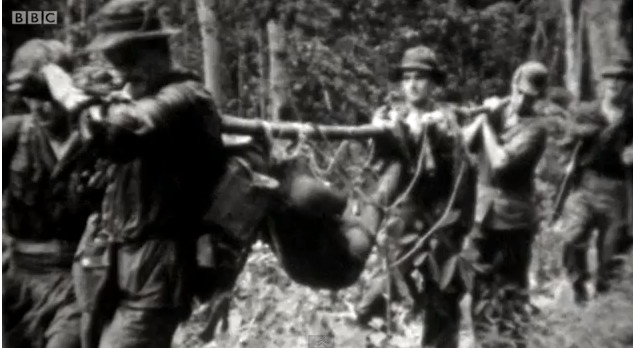
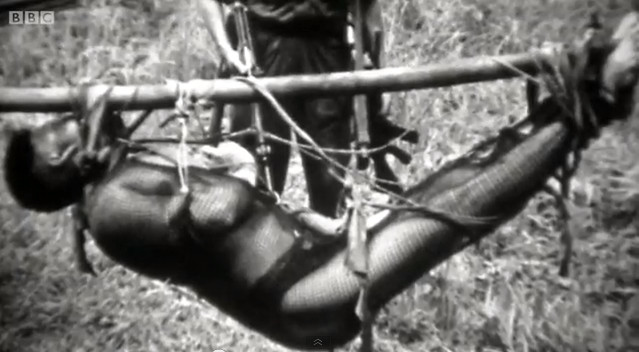
This reality shows only a evil sadistic perverse lying bullyboy!
The little sadistic bully boy General Sir Frank Edward Kitson GBE, KCB, MC & Bar, DL was awarded the Military Cross for service in Kenya. This was before he set up British Crown terrorist murder and torture squads in Northern Ireland.
"
It is probably for good reason why Kitson would not wish to co-operate with court proceedings as he might not fair well in them. A copy of his book Gangs and Counter-Gangs might provide sufficient incriminating material on him. One example of his candour in the book is when he tells his reader about his knowledge that a suspected Mau Mau was hiding under a bundle of clothes. He knew the man was there and he plunged his machette into the bundle until he 'felt the satisfaction of the blade finding its target while the man howled in pain'
The book might prove to be a useful reference in court."
The British Queen decorates her own terrorists.
Sad but no shock, to witness the BBC, (who usually like to professionally finger point) attempt to trivialize any of the many crimes of their own empire.
It is the scale of the British atrocities in Kenya that is the most startling revelation of this book.
Independent reviews of the book.
Imperial Reckoning. The untold story of Britain's Gulag in Kenya
Forty years after Kenyan independence from Britain, the words "Mau Mau" still conjure images of crazed savages hacking up hapless white settlers with machetes. The British Colonial Office, struggling to preserve its far-flung empire of dependencies after World War II, spread hysteria about Kenya's Mau Mau independence movement by depicting its supporters among the Kikuyu people as irrational terrorists and monsters. Caroline Elkins, a historian at Harvard University, has done a masterful job setting the record straight in her epic investigation, Imperial Reckoning. After years of research in London and Kenya, including interviews with hundreds of Kenyans, settlers, and former British officials, Elkins has written the first book about the eight-year British war against the Mau Mau.
She concludes that the war, one of the bloodiest and most protracted decolonization struggles of the past century, was anything but the "civilizing mission" portrayed by British propagandists and settlers. Instead, Britain engaged in an amazingly brutal campaign of ethnic cleansing that seemed to border on outright genocide. While only 32 white settlers were killed by Mau Mau insurgents, Elkins reports that tens of thousands of Kenyans were slaughtered, perhaps up to 300,000. The British also interned the entire 1.5 million population of Kikuyu, the colony's largest ethnic group, in barbed-wire villages, forced-labour reserves where famine and disease ran rampant, and prison camps that Elkins describes as the Kenyan "Gulag." The Kikuyu were subjected to unimaginable torture, or "screening," as British officials called it, which included being whipped, beaten, sodomized, castrated, burned, and forced to eat feces and drink urine. British officials later destroyed almost all official records of the campaign. Elkins infuses her account with the riveting stories of individual Kikuyu detainees, settlers, British officials, and soldiers. This is a stunning narrative that finally sheds light on a misunderstood war for which no one has yet been held officially accountable. --Alex Roslin
Kenyan victims of British brutality
Johann Hari writes that We owe it to do right by the Kenyan victims of British brutality.
In a few weeks, a group of quiet, dignified elderly men and women will arrive in London to explain how the forces of the British state crushed their testicles or breasts with pliers. It was part of a deliberate policy of breaking a civilian population who we regarded as 'baboons', 'barbarians' and 'terrorists'.
They will come bearing the story of how Britain invaded a country, stole its land, and imprisoned an entire civilian population in detention camps ' and they ask only for justice, after all this time.
As a small symbol of how we as a country have not come to terms with our history, compare the bemused reaction to the arrival of these Kenyan survivors of Britain's gulags to the recent campaign supporting the Gurkhas. We have all waxed lyrical over the Nepalese soldiers who were, for two centuries, hired by the British Empire to fight its battles. Sometimes they were used in great causes, like the defeat of Nazism. Sometimes they were used to crush democratic movements in India or Malaya or Pakistan. But they did the bidding of the Empire ' so they are that rare bunch of foreigners whom the right will welcome. I too strongly supported their rights to reside in Britain, out of simple humanity ' if they're good enough to die for us, they're good enough to live with us. But isn't it revealing that even in 2009, we can cheer the servants of Empire but blank the people mutilated and murdered by it?
There will be no press campaigns or celebrity endorsements for the survivors of the Kenyan suppression when they issue a reparations claim in London next month. They will be met with a bemused shrug. Yet their story tells us far more.
The British arrived in Kenya in the 1880s, at a time when our economic dominance was waning and new colonies were needed. The Colonial Office sent in waves of white settlers to seize the land from the local 'apes' and mark it with the Union Jack. Francis Hall was the officer of the East India Company tasked with mounting armed raids against the Kikuyu ' the most populous local tribe ' to break their resistance. He said: 'There is only one way of improving the [Kikuyu] and that is to wipe them out; I would only be too delighted to do so but we have to depend on them for food supplies.'
The British troops stole more than 60,000 acres from the Kikuyu, and renamed the area 'the White Highlands.' But the white settlers were aristocratic dilettantes with little experience of farming, and they were soon outraged to discover that the 'primitives' were growing food far more efficiently on the reserves into which they had been driven. So they forced the local black population to work 'their' land, and passed a law banning local Africans from inde-pendently growing the most profitable cash crops ' tea, coffee, and sisal.
The people of Kenya objected, and tried to repel the invaders. They called for ithaka na wiyathi ' land and freedom. After peaceful protests were met with violence, they formed a group, dubbed the Mau Mau, to stop the suppression any way they could. They started killing the leaders appointed by the British, and some of the settlers too. As a result, the London press described them as 'evil savages' and 'terrorists' who were motivated by hatred of Christianity and civilisation. They had been 'brainwashed' by 'Mau Mau cult leaders', the reports shrieked. The 1.5 million Kikuya overwhelmingly supported the Mau Mau and independence ' so the British declared war on them all. A state of emergency was announced, and it began with forced removals of all Kikuyu. Anybody living outside the reserves ' in any of the cities, for example ' was rounded up at gunpoint, packed into lorries, and sent to 'transit camps'. There, they were 'screened' to see if they were Mau Mau supporters. One of the people locked up this way for months was Barack Obama's grandfather.
Professor Caroline Elkins, who studied the detention camps for five years for her remarkable book Britain's Gulag: The Brutal End of Empire in Kenya, explains the tactics adopted by the British to snuffle out Mau Mau. 'Electric shock was widely used, as well as cigarettes and fire,' she writes. 'Bottles (often broken), gun barrels, knives, snakes, vermin and hot eggs were thrust up men's rectums and women's vaginas. 'The screening teams whipped, shot, burned, and mutilated Mau Mau suspects.'
The people judged to be guilty of Mau Mau sympathies were transferred to torture camps. There, each detainee was given a number which they had to wear on a band on their wrist. They were then stripped naked and sent through a cattle dip, before the torture would begin again. 'Detainees were frog-marched around the compound and beaten until blood ran from their ears,' Elkins writes.
The Kikuyu survivor Pascasio Macharia describes some of the tortures he witnessed: 'The askaris [guards] brought in fire buckets full of water, and the detainees were called one by one, [my friend] Peterson first. The askaris then put his head in the bucket of water and lifted his legs high in the air so he was upside down. That's when [one of the camp commandants] started cramming sand in Peterson's anus and stuffed it in with a stick. The other askari would put water in, and then more sand. They kept doing this back and forth ' Eventually they finished with Peterson and carried him off, only to start on the next detainee in the compound.'
Another favoured torment was to roll a man in barbed wire and kick him around until he bled to death. Typhoid, dysentry and lice scythed through the population. Castration was common. At least 80,000 people were locked away and subjected to torture like this .
When I reported from Kenya earlier this year, I met elderly people who still shake with fear as they talk about the gulags. William Baldwin, a British member of the Kenya Police Reserve, wrote a memoir in which he cheerfully admits to murdering Kikuya 'baboons' in cold blood. He bragged about how he gutted them with knives while other suspects watched. Another British officer, Tony Cross, proudly called their tactics 'Gestapo stuff'. For the civilians outside, life was only slightly better. Women and children were trapped in 800 'sealed villages' throughout the countryside. They were surrounded by barbed wire and armed guards, and forced at gunpoint to dig trenches that sealed them off from the world.
There was always another, honourable Britain that fought against these crimes. The Labour left ' especially Barbara Castle and Nye Bevan ' fought for the camps to be exposed and shut. They didn't succeed until the British imperialists were finally forced to scuttle away from the country entirely. We will never know how many people they murdered, because the colonial administration built a bonfire of all the paperwork on their way out the door. Elkins calculates it is far more than the 11,000 claimed by the British Government, and could be as many as 300,000.
Yet in Britain today, there is a blood-encrusted blank spot about Empire. On the reality show The Apprentice, the contestants recently had to pick a name for their team, and they said they wanted 'something that represented the best of British' ' so they settled on 'Empire'. Nobody objected. Imagine young Germans blithely naming a team 'Reich': it's unthinkable, because they have had to study what their fathers and grandfathers did, and expunge these barbarous instincts from their national DNA.
This failure to absorb the lessons of Empire is not only unjust to the victims; it leads us to repeat horrifying mistakes. Today, we are ' with the Americans ' using unmanned drones to bomb the Pakistan-Afghan borderland, as we did a few years ago in Iraq. Nobody here seems to remember that the British invented aerial counter-insurgency in this very spot ' with disastrous consequences.
In 1924, Arthur 'Bomber' Harris bragged that all rebellion could be stopped with this tactic. We have shown them, 'what real bombing means, in casualties and damage: they know that within 45 minutes, a full-sized village can be practically wiped out and a third of its inhabitants killed,' he said. Yet instead of 'pacifying' them, it radically alienated the population and lead to an uprising. If we knew our history, we would not be running the same script and expecting a different ending.
Gordon Brown said last year (in India, of all places) that 'the days of Britain having to apologise for its colonial history are over'. The survivors of England's blanked-out torture camps are entitled to ask: when did we start?
pulsemedia.org/2009/05/30/kenyan-victims-british-brutality/
Imperial Reckoning: The Untold Story of Britain's Gulag in Kenya
The UK knows about Obama's Grandfather. He was a soldier for the British and they tortured him after they used him. These horrific events of British torture and oppression in Kenya have much in common with the treatment of the Irish volunteers in the first World War.
From archives of the UK's Times:
Beatings and abuse made Barack Obama's grandfather loathe the British
December 3, 2008
Ben Macintyre and Paul Orengoh
The President-elect's relatives have told how the family was a victim of the Mau Mau revolt
Barack Obama's grandfather was imprisoned and brutally tortured by the British during the violent struggle for Kenyan independence, according to the Kenyan family of the US President-elect.
Hussein Onyango Obama, Mr Obama's paternal grandfather, became involved in the Kenyan independence movement while working as a cook for a British army officer after the war. He was arrested in 1949 and jailed for two years in a high-security prison where, according to his family, he was subjected to horrific violence to extract information about the growing insurgency.
'The African warders were instructed by the white soldiers to whip him every morning and evening till he confessed,' said Sarah Onyango, Hussein Onyango's third wife, the woman Mr Obama refers to as 'Granny Sarah'.
Mrs Onyango, 87, described how 'white soldiers' visited the prison every two or three days to carry out 'disciplinary action' on the inmates suspected of subversive activities.
'He said they would sometimes squeeze his testicles with parallel metallic rods. They also pierced his nails and buttocks with a sharp pin, with his hands and legs tied together with his head facing down,' she said The alleged torture was said to have left Mr Onyango permanently scarred, and bitterly anti-British. 'That was the time we realised that the British were actually not friends but, instead, enemies,' Mrs Onyango said. 'My husband had worked so diligently for them, only to be arrested and detained.'
Mr Obama refers briefly to his grandfather's imprisonment in his best-selling memoir, Dreams from My Father, but states that his grandfather was 'found innocent' and held only for 'more than six months'.
Mr Onyango served with the British Army in Burma during the Second World War and, like many army veterans, he returned to Africa hoping to win greater freedoms from colonial rule. Although a member of the Luo tribe from western Kenya, he sympathised with the Kikuyu Central Association, the organisation leading an independence movement that would evolve into the bloody uprising known as the Mau Mau rebellion.
'He did not like the way British soldiers and colonialists were treating Africans, especially members of the Kikuyu Central Association, who at the time were believed to be secretly taking oaths which included promises to kill the white settlers and colonialists,' Mrs Onyango said.
In his book, Mr Obama implies that his grandfather was not directly involved in the anti-colonial agitation, but his grandmother said that her husband had supplied information to the insurgents. 'His job as cook to a British army officer made him a useful informer for the secret oathing movement which would later form the Mau Mau rebellion,' she said. The Mau Mau used oaths as part of their initiation ceremony.
Mr Onyango was probably tried in a magistrates' court on charges of political sedition or membership of a banned organisation, but the records do not survive because all such documentation was routinely destroyed in British colonies after six years.
'To arrest a Luo ex-soldier, who must have been a senior figure in the community, is pretty serious. They must have had some damn good evidence,' said Professor David Anderson, director of the African Studies Centre at the University of Oxford and an authority on the Mau Mau rebellion.
The British responded to the Mau Mau uprising with draconian violence: at least 12,000 rebels were killed, most of them Kikuyu, but some historians believe that the overall death toll may have been more than 50,000. In total, just 32 European settlers were killed.
According to his widow, Mr Onyango was denounced to the authorities by his white employer, who sacked him on suspicion of consorting with 'troublemakers'. He may also have been the victim of a feud with an African neighbour who worked in the district commissioner's office. Mr Onyango, notoriously outspoken, appears to have accused this official of corruption.
According to Mrs Onyango, her husband was arrested by two soldiers, and taken to Kamiti prison, the national maximum-security prison outside Nairobi.
'This was like a death camp because some detainees died while being tortured,' Mrs Onyango said. 'We were not allowed to see him, not even taking him food.' She said her husband was told that he would be killed or maimed if he refused to reveal what he knew of the insurgency, and was beaten repeatedly until he promised 'never to rejoin any groupings opposed to the white man's rule'. Even after he had confessed, and renounced the insurgency, the physical abuse allegedly continued.
Some of Mr Onyango's fellow inmates were beaten to death with clubs, according to Mrs Onyango. 'In fact, my late husband was lucky to have left the prison alive without any serious bodily harm, save for the permanent scars from beatings and torture, which remained on his body till he died.'
Like all family histories, retold many years after the events, some elements of Mrs Onyango's account are hazy. For example, the white men she described as 'soldiers' are far more likely to have been Special Branch officers, who wore a uniform that was indistinguishable from military uniform to most Africans.
Mrs Onyango also described an incident of her husband's 'torture', which was nothing of the sort. 'The white soldiers would spray his body with an itching chemical. This, he said, could make him scratch his body till it bled.' Almost certainly, Mr Onyango was being treated for body lice but apparently he was so used to brutality that he assumed the routine chemical delousing treatment was another form of abuse.
During Mr Obama's first visit to Kenya in 1988, his grandmother recalled the growing resentment against white colonial rule in Kenya, with rallies and mounting violence that would explode into full-scale rebellion in 1952. 'Most of this activity centred on Kikuyuland,' she told him. 'But the Luo, too, were oppressed, a main source of forced labour. Men in our area began to join the Kikuyu in demonstrations . . . many men were detained, some never to be seen again.'
The British colonial authorities began a sustained campaign to quell the Mau Mau uprising, establishing numerous detention camps that some historians describe as 'Kenya's Gulag', where inmates were frequently abused. 'There was torture in Kenya during the Mau Mau emergency, institutional and systematic, and also casual and haphazard,' Professor Anderson writes in Histories of the Hanged: Britain's Dirty War in Kenya and the End of Empire (2005). 'Violence . . . was intrinsic to the system, and the use of force to compel obedience was sanctioned at the highest level.'
At the height of the rebellion, an estimated 71,000 Kenyans were held in prison camps. The vast majority were never convicted. Letters smuggled out of the camps complained of systematic brutality by warders and guards. According to the Harvard historian Caroline Elkins, who won a Pulitzer Prize for her expos' of British atrocities during the Mau Mau uprising, there were reports of sexual violence and mutilation using 'castration pliers'. 'This was an instrument devised to crush the men's testicles,' she writes in Britain's Gulag: The Brutal End of Empire in Kenya (2005). 'Other detainees also described castration pliers, along with other methods of beating and mutilating men's testicles.'
Several hundred letters from camp inmates survive in the Kenyan National Archives, 'chronicling camp conditions, forced labour, torture, starvation and murder', according to Ms Elkins. One white policeman, Duncan McPherson, told Barbara Castle, the former MP, that conditions in some detention camps were 'worse, far worse, than anything I experienced in my 4' years as a prisoner of the Japanese'.
Mr Onyango was 56 when he was arrested, and he emerged from imprisonment prematurely aged and deeply embittered. In his memoir, Mr Obama described his grandfather's shocking physical state: 'When he returned to Alego he was very thin and dirty. He had difficulty walking, and his head was full of lice.' For some time, he was too traumatised to speak about his experiences. Mrs Onyango told her grandson: 'From that day on, I saw that he was now an old man.'
Understandably, Mr Onyango held a lifelong grudge against the British for the way he had been treated.
Mr. Churchill was the Prime Minister of the United Kingdom in 1951, when this happened.
|
|
|
|
|
|
|
|
|
|


 Login here and be redirected to this Topic
 Register
 Search
 FAQ
FAQ